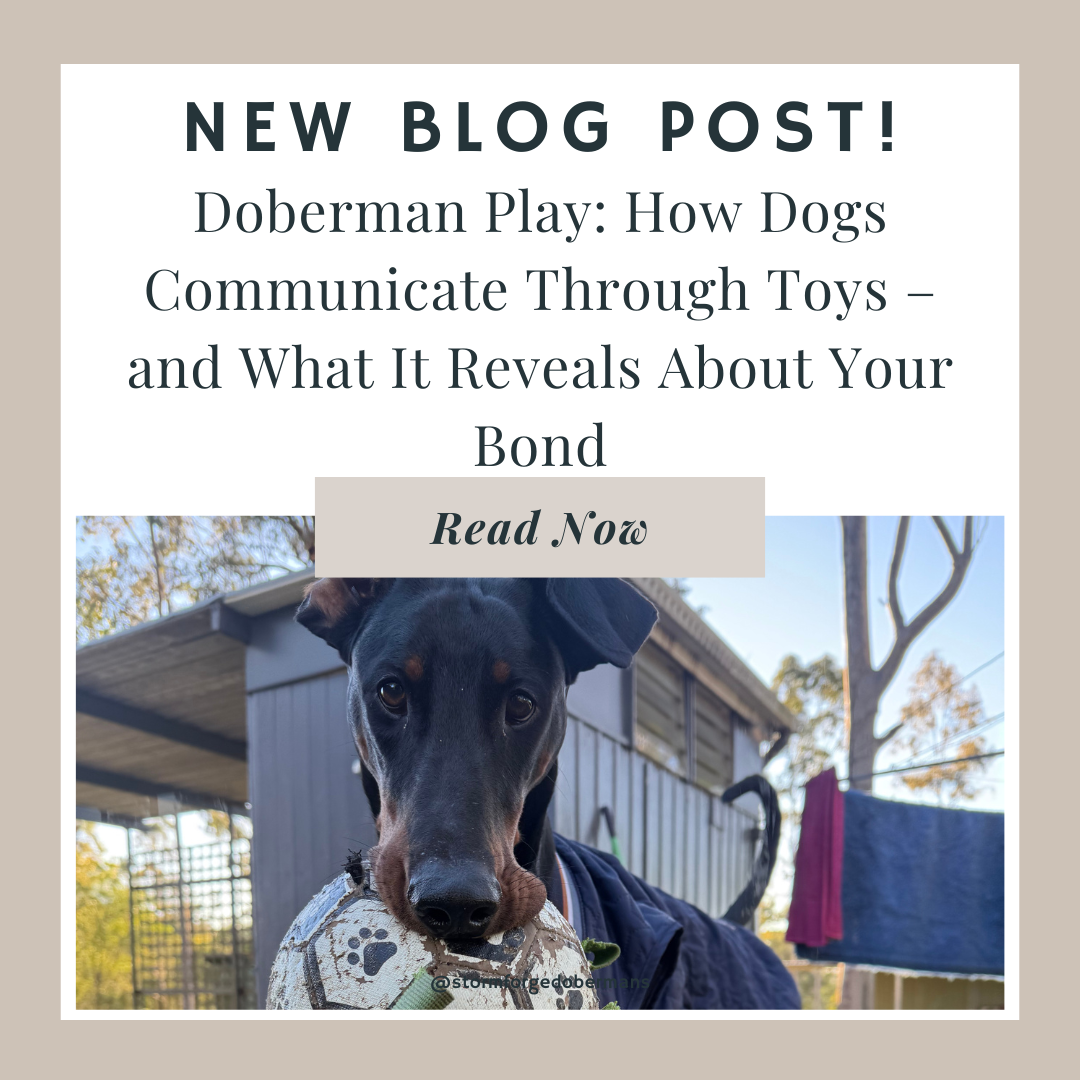
Most of us have watched a dog pick up a toy, chew it, toss it, or bring it over. It looks simple, but play is communication—structured, deliberate, and revealing. Through play, a dog shows what sits beneath the surface: nerve, confidence, and the quality of connection with the handler. Every movement has a purpose. Grip, release, re-bite, posture—they all tell a story if we know how to read it.
A few weeks ago, Jett reminded me of that. She picked up a plush toy, bit softly, released, then adjusted her hold. When she brought it to me, she tucked her nose and braced through her front legs. It wasn’t defensive or avoidant. It was presence—controlled, social, and confident. To the untrained eye, it would look like playful energy. To me, it was communication: her saying, I’m engaged. Meet me here.
Doberman play is rarely random. It’s feedback, emotional regulation, and social dialogue rolled into one behaviour. Reading that dialogue gives a clear view into the dog’s nervous system and the relationship that shapes it.
Table of Contents
Why Toy Play Is More Than Play
Doberman play isn’t entertainment. It’s emotional work. Through it, dogs regulate arousal and stress, practise coordination, and test social engagement. It’s also a behavioural mirror. The way a Doberman plays with its handler reflects the state of the bond—trust, clarity, and willingness to stay connected through energy.
When we treat play as separate from training, we miss how much information lives inside it. Play is the most accessible window into the dog’s emotional stability. It shows how they respond to novelty, conflict, and cooperation—all the elements that later determine reliability under pressure.
Why Doberman Play Is Often Misread
Doberman play is frequently misinterpreted. Many handlers see tug as a way to drain energy or teach grip. Others view softer Doberman play as disinterest. But each adjustment in pressure, each glance and pause, carries meaning. It’s not drive alone—it’s communication through movement.
Dogs don’t speak in words; they express through patterns. The rhythm of engagement, release, and recovery tells you whether the dog is confident or uncertain. If we only measure obedience and ignore those subtler cues, we lose the data that matters most: how safe the dog feels in our presence.
Breaking Down Jett’s Sequence
Jett’s interaction unfolded as a sequence: pick up, explore, present, engage. Each action had intent. The soft initial bite reflected curiosity and self-control. The re-bite showed problem-solving—the search for the correct hold. The act of bringing the toy was trust, a decision to include me in the process. Her final brace was readiness: confidence expressed through posture.
In that short exchange, she revealed nerve, clarity, and partnership. She wasn’t simply entertaining herself. She was checking whether I was reading the conversation accurately.
The Meaning of a Soft Bite
A soft bite is often overlooked. It signals emotional balance—a dog able to explore stimulus without losing composure. Where a frantic grip shows insecurity, a soft exploratory bite shows confidence in recovery. The dog isn’t driven by compulsion; it’s experimenting, gathering data.
Re-biting within that calm state is healthy. It’s not uncertainty; it’s adjustment. In Doberman training, this distinction matters. A calm, thoughtful grip demonstrates stability under arousal, something far more valuable than intensity alone.
Inviting the Human In
When a dog brings a toy, it’s not surrender. It’s invitation. That gesture says, join me in this pressure, let’s work together. For a confident Doberman, this is social play—a controlled exchange where drive meets connection.
Understanding the motive behind that invitation shapes how we respond. If we grab too quickly or over-control, we close the conversation. If we meet it calmly, we build trust under motion. Each shared tug becomes a rehearsal for pressure management and cooperative drive work.
The Tug Posture and What It Communicates
In Jett’s case, when she tucked her nose and grounded through her front legs, it was a clear signal of readiness. That posture—loose spine, forward weight, soft eyes—says the dog is prepared for conflict play. It’s not aggression. It’s confidence expressed physically.
This defensive-tug stance shows a willingness to meet resistance and stay social through it. In the working Doberman, this is the balance point between nerve and drive—the ability to feel pressure and remain mentally clear.
Understanding the Predatory Motor Pattern
Toy work sits within the predatory sequence: orient, eye, stalk, chase, grab-bite, shake, dissect, consume. Each breed emphasises different elements. Terriers hold and shake. Retrievers carry. Herding dogs fixate on the eye.
Dobermans sit in the middle, often favouring the chase-grab-shake chain. The toy becomes safe prey, allowing the dog to express instinct in a controlled social setting. When Jett bit, released, and re-bit, she was running that sequence in miniature—regulated drive, shaped through relationship.
Recognising this biological framework helps trainers work with, not against, natural behaviour. It turns play into a pressure valve rather than a battle for control.
Social Play Versus Solo Play
Solo play is self-regulation. Social play is relationship. When a Doberman chooses to bring the toy to the handler, it risks loss and chooses connection anyway. That’s trust made visible.
Social play develops emotional agility. The dog experiences arousal, resistance, and resolution with us as part of the process. Through this repetition, confidence becomes shared. The dog learns that tension doesn’t end the game; it strengthens it.
Case Study: What Jett’s Session Revealed
That short moment with Jett captured several layers of what defines a stable working Doberman.
Nerve: She remained clear under arousal. No freezing, no frantic escalation, no avoidance. Just steady engagement.
Social confidence: She wanted me in the interaction. Dogs uncertain of their place often retreat or guard the toy. She invited cooperative conflict—a hallmark of security.
Drive modulation: She accessed prey energy without losing clarity. The re-bites were deliberate, not scattered. That control under stimulation is what separates balanced working dogs from reactive ones.
Desire for shared challenge: She wasn’t chasing a win; she was seeking a contest. Her posture said, I can handle pressure—can you?
Every repetition of that pattern reinforces the channel of communication between us. It’s not about winning the game; it’s about testing connection under stress.
The Layer Beneath: Connection, Confidence, and Co-Regulation
Doberman play through toys operates on three interlocking layers.
Connection: The dog’s choice to engage socially shows relational safety. When we meet them there, rather than controlling or redirecting, the bond deepens.
Confidence: Confident dogs initiate challenge. They step into opposition without fear of loss. That’s the confidence Jett displayed—a quiet certainty rather than bravado.
Co-regulation: Play teaches emotional flexibility. When a dog can rise into excitement and return to calm while staying connected to us, co-regulation is in place. It’s the nervous system learning balance through partnership.
This is the foundation of reliable working behaviour. A dog that can stay mentally linked through arousal will stay clear under real-world pressure.
Reading Your Dog During Play
Observation turns play into data.
- Bite quality: A soft exploratory grip indicates curiosity and safety. A full, still bite shows confidence. Choppy or inconsistent chewing suggests over-stimulation or insecurity.
- Facial expression: Relaxed eyes and open mouth equal social play. Fixed eyes and tension around the muzzle indicate conflict or possession.
- Invitations: Bringing the toy to the handler is trust. Avoidance or withdrawal signals uncertainty.
- Recovery: Fast re-engagement after losing the toy shows resilience.
- Pauses: Brief breaks mid-game are processing, not disinterest. They reflect cognitive engagement and self-control.
These small markers reveal the state of the relationship far more accurately than any obedience score.
Why It Matters Beyond Play
Play behaviour mirrors broader temperament. A dog that manages pressure through play will manage it in work. The same stability that allows clean toy work supports confident obedience, recall, and protection routines.
When we build play as cooperation rather than control, we teach the dog that arousal is safe, pressure is shared, and recovery is part of the process. This mindset produces balanced, thoughtful Dobermans capable of clarity under stress—exactly what the breed was designed for.
Connection always precedes control. Play is not separate from training; it’s the first language of it.
Building Stability Through Toy Work
To develop emotional balance through play, focus on quality over intensity.
- Match energy: Respond when the dog invites rather than always initiating. Meeting their rhythm builds trust.
- Allow resistance: Tug is not dominance. It’s social conflict resolved through cooperation.
- Don’t rush transitions: Re-biting and repositioning are communication. Let them happen.
- Reflect calm energy: The dog mirrors our state. Neutral handling teaches that arousal doesn’t equal chaos.
- Reward curiosity: When the dog investigates instead of freezing, mark it. Curiosity builds confidence.
These moments, repeated over time, create stability. The dog learns that pressure leads to understanding, not uncertainty.
Final Reflection
That brief moment with Jett could have gone unnoticed. Instead, it revealed a complete conversation—confidence, nerve, and trust expressed through play. Her ability to invite challenge, regulate drive, and maintain soft focus showed what balanced working temperament looks like in practice.
Doberman play is never trivial. It’s the most accessible diagnostic of connection we have. When we learn to read it accurately, we stop seeing toys as distractions and start seeing them as data.
Sometimes the clearest communication happens in movement—the quiet rhythm between grip and release, the pause before engagement, the calm that follows excitement. Inside that rhythm lies the truth of the relationship: two nervous systems learning to stay in sync, even when the world asks them to move.
Leave a Reply