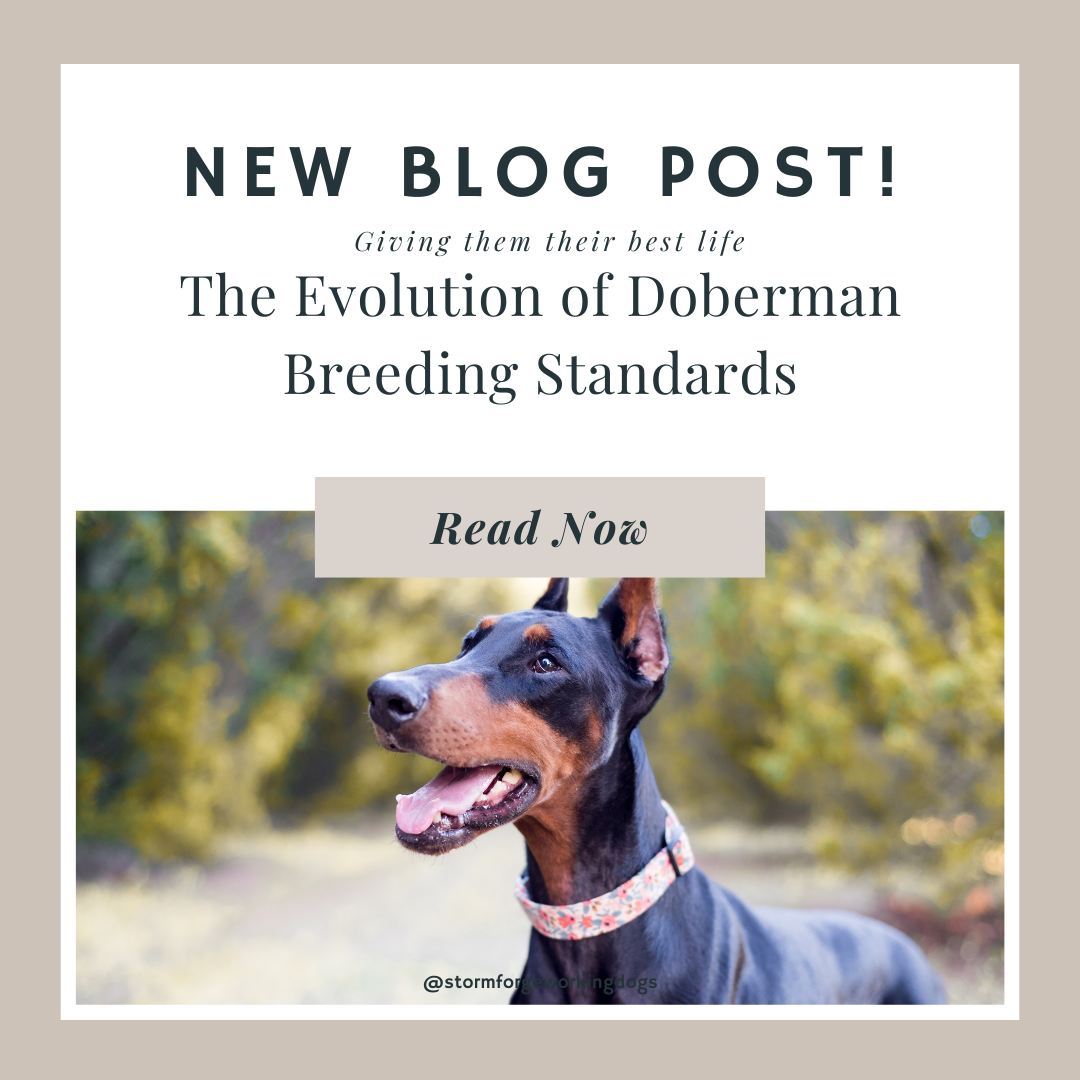
Doberman breeding has come a long way since the late 19th century, evolving from the creation of a loyal working protector into a refined, intelligent, and versatile breed admired around the world.
The Doberman Pinscher’s sleek appearance and commanding presence are the result of decades of thoughtful breeding practices and shifting standards.
Understanding how these breeding standards have evolved offers insight into why the modern Doberman looks and behaves the way it does today — and how breeders continue to shape its future.
Table of Contents
Origins of the Doberman
The Doberman’s story begins in late 19th-century Germany with a man named Louis Dobermann, a tax collector who wanted a loyal, protective companion to accompany him on his rounds. He lived in the town of Apolda, in the state of Thuringia, where he had access to various working dog breeds through his secondary role as a dog warden.
Dobermann’s goal was simple but ambitious: to create a medium-sized, intelligent, and fearless guardian — a dog that combined alertness, endurance, and devotion. To achieve this, he selectively bred dogs such as the German Pinscher, Rottweiler, Weimaraner, Greyhound, and possibly the Beauceron. Each contributed something to the final result: the Pinscher’s drive, the Rottweiler’s strength, the Greyhound’s agility, and the Weimaraner’s intelligence and sensitivity.
The earliest Dobermans were bred for function, not form. Their appearance varied, but their reputation grew quickly. They were courageous, loyal, and quick learners — traits that made them ideal for guarding, police, and military work.
By the early 1900s, Dobermans had spread across Europe. The breed’s usefulness in service roles earned it admiration, and dog fanciers soon began to formalise its characteristics.
The Establishment of Breed Standards
The Early Years
As the Doberman gained recognition, breed clubs emerged to preserve its identity and guide its development. The first official doberman breed standard was written in Germany in 1899, setting the foundation for what we now recognise as the Doberman Pinscher. This standard emphasised the breed’s purpose as a protection and working dog — courageous, intelligent, and reliable.
When Dobermans arrived in the United States and other countries in the early 20th century, local kennel clubs began adapting the German standard to their own needs. The Doberman Pinscher Club of America (DPCA), founded in 1921, formalised the American version of the doberman breed standard. It described a dog that was both elegant and powerful — a balance of form and function.
Early Standards: Working First, Looks Second
In those early decades, appearance was secondary to temperament and ability. The standard left room for variation, allowing breeders to experiment with type and structure as long as the dog could perform its duties. Dobermans were valued for their courage and composure under pressure, rather than the precision of their angles or markings.
These first generations of Dobermans were described as “sharp” and highly driven — dogs with a strong instinct to protect and an independent nature. That intensity made them excellent working dogs but sometimes challenging companions for inexperienced handlers.
Mid-Century Refinement
As the Doberman’s popularity grew, so did the interest in exhibiting them in dog shows. This period — particularly from the 1940s to the 1970s — marked the beginning of a shift in priorities. Breeding began to favour uniformity in appearance alongside temperament, leading to refinements in structure, coat, and proportion.
Kennel clubs like the AKC (American Kennel Club) and FCI (Fédération Cynologique Internationale) began enforcing more precise standards. Traits such as ear set, topline, chest depth, and angulation became highly regulated. The now-iconic cropped ears and docked tail — initially practical features to prevent injury in working dogs — became part of the aesthetic identity of the breed.
During this time, Dobermans were also imported to Australia and adapted to local conditions. The Australian National Kennel Council (ANKC) eventually developed a doberman breed standard closely aligned with the FCI version but with slight modifications to reflect Australian climate and breeding priorities.
Modern Breed Standards
Appearance and Structure
Today’s doberman breed standards across the world share common traits but differ subtly between regions.
- FCI (Europe): Emphasises strength, endurance, and working temperament. Males typically stand 68–72 cm and females 63–68 cm. The look is more substantial, with pronounced muscle tone and a confident stance.
- AKC (United States): Focuses on elegance and balance, with a slightly leaner outline.
- ANKC (Australia): Maintains the FCI’s structure and proportion guidelines but allows for natural ears and tails following animal welfare reforms.
Across all regions, the Doberman is expected to embody athleticism — a square build, firm topline, and a coat that’s short, smooth, and close-lying. Accepted colours are black, red, blue, and fawn (Isabella), each with clearly defined rust markings.
Temperament
Modern standards describe the Doberman as energetic, watchful, determined, and loyal. A sound temperament is paramount: the ideal Doberman should be confident but not reckless, alert without being anxious, and affectionate with family while remaining naturally protective.
Balanced temperament is now a cornerstone of breeding programs. Dogs that show excessive shyness, reactivity, or aggression are discouraged from breeding, as stability and sociability are key to the breed’s future.
Functionality
Despite increasing emphasis on beauty and symmetry, the Doberman is still recognised as a working breed. It should remain agile, trainable, and capable of performing tasks ranging from obedience to personal protection and scent detection.
This balance between form and function continues to spark discussion within the community. While some lines are bred primarily for the show ring, others prioritise working performance. The healthiest breeding approach lies somewhere in between — maintaining the breed’s athleticism, intelligence, and versatility without losing the refinement that defines its silhouette.
Divergence of Show and Working Lines
The mid- to late 20th century saw the Doberman diverge into two general categories: show lines and working lines.
Show lines were bred to meet aesthetic ideals — symmetrical conformation, balanced movement, and a calmer temperament suited to public exhibition. These dogs often have a more polished, elegant look and a slightly softer disposition, making them excellent family companions and competitors in obedience or agility.
Working lines, on the other hand, prioritise drive, nerve strength, and resilience. These dogs retain the original purpose of the breed — protection and utility. They often possess higher energy levels, quicker reactions, and a more intense working focus. European working Dobermans, in particular, are known for their courage and clarity under pressure.
In Australia, breeders often seek a balance between the two — producing dogs that can perform in sports and protection while still maintaining the composure and beauty expected in the show ring. This dual-purpose approach has helped Australian Dobermans develop a distinctive type that’s both functional and refined.
Health and Longevity
The evolution of breeding standards has brought both benefits and challenges. While standardisation has helped preserve the Doberman’s identity, it has also introduced health concerns linked to limited genetic diversity.
Common hereditary issues include dilated cardiomyopathy (DCM), von Willebrand’s disease (vWD), hip dysplasia, and hypothyroidism. Responsible breeders today use advanced genetic testing, cardiac screening, and health registries to reduce the risk of these conditions.
Breed clubs worldwide — including those in Australia — are promoting initiatives to improve transparency around health results. Open health registries and partnerships with veterinary universities are helping breeders make data-driven decisions.
Another shift in recent decades is the focus on holistic conditioning — nutrition, exercise, and emotional health are now considered just as important as genetics. Raw or fresh feeding, structured socialisation, and mental stimulation are increasingly emphasised in breeding and ownership circles.
The Debate Around Cropping and Docking
One of the most visible changes in Doberman breeding standards has been the decline of ear cropping and tail docking in many countries.
Historically, these procedures were done to prevent injury during work and to create a cleaner, alert appearance. In modern times, however, animal welfare legislation has changed perceptions. In Australia, both cropping and docking are now largely banned, and the natural look has become the accepted standard.
While some purists argue that the cropped silhouette reflects the breed’s heritage, many enthusiasts appreciate the natural appearance, which better reflects the breed’s true anatomy. Over time, judges and breeders have adapted to this evolution, and Australian Dobermans now proudly represent both tradition and progress.
The Role of Genetics and Technology
Modern breeding has entered an era of science-based precision. Advances in canine genetics allow breeders to identify carriers of diseases before breeding occurs, vastly improving outcomes.
DNA profiling, cardiac ultrasound screening, and artificial insemination using frozen semen from international studs have all expanded the breed’s potential gene pool. This global connectivity allows Australian breeders to maintain genetic diversity and continue improving structural and health outcomes.
Technology has also increased accountability. Breeders can now publicly share test results, pedigrees, and performance data, giving potential puppy buyers transparency and confidence in ethical practices.
Ethical Breeding and Preservation of the Breed
With modern awareness comes responsibility. Reputable breeders around the world, including those in Australia, are shifting towards preservation breeding — a philosophy that prioritises the long-term wellbeing of the breed over short-term success.
Preservation breeders balance health, function, and temperament while staying true to the original purpose: a loyal, courageous, and intelligent companion. This approach recognises that beauty means little without soundness, and that true Doberman character lies in its versatility and heart.
Doberman breed clubs and advocacy groups are also engaging the next generation of breeders through mentorship programs, health education, and transparent dialogue about ethics. This collective commitment ensures the Doberman remains both noble and robust well into the future.
The Future of Doberman Breeding Standards
As the world changes, so too will the Doberman. Breeders are increasingly focused on sustainability — not only in health but in behaviour and adaptability.
Future standards may prioritise temperament stability, genetic diversity, and functional structure over purely aesthetic criteria. The ideal Doberman of the future will likely be one that can excel equally in sport, protection, and companionship while living a long, healthy life.
There’s also growing collaboration between countries through international kennel clubs, allowing data sharing and cooperation that transcends borders. For Australian breeders, this global network ensures continued access to world-class genetics and training philosophies.
Embracing the Doberman’s Legacy
The evolution of Doberman breeding standards tells a story of balance — between beauty and function, tradition and progress, passion and responsibility.
From Louis Dobermann’s early vision of a loyal protector to today’s refined yet powerful companions, the breed’s journey mirrors our own human evolution — a continual effort to refine without losing essence.
For those who love the breed, understanding its history and standards isn’t just academic — it’s a way of honouring what the Doberman stands for: intelligence, courage, loyalty, and grace.
As breeders, trainers, and owners continue to shape the next generation, one truth remains constant — the Doberman will always be more than a dog. It’s a legacy of purpose, devotion, and enduring partnership.

Leave a Reply