
Last week I spent two days completing the practical component of the Security Operations K9 Handler Course, and it shifted more in me than I expected.
I worked dogs at different stages, sat in on client sessions, watched real problems unfold in front of me, and felt myself confronting a few of my own.
It was intense, eye-opening, and strangely grounding.
I wrote everything down because I don’t want to forget what these two days taught me — so here they are, my field notes exactly as they unfolded.
Table of Contents
Day One: Starting in the Scenario Area and Sitting in on Client Sessions
The day didn’t begin with sleeves or bitework. It eased in slowly, the kind of start that doesn’t feel like much at first… until you realise how much it’s setting you up for everything that comes next as a developing K9 handler.
We began in the new scenario area — two days of real dogs, real pressure, and the kind of learning you only get when you’re actually on the field — but the morning itself was quiet.
At Jett’s training place, they’re building all these obstacles and structures — corners, tight entries, concealment spots, wall obstacles — and just walking through it with the trainers already shifted how I look at training as a K9 handler in development.
It wasn’t “here’s the obstacle.”
It was “here’s what this obstacle teaches the dog about pressure, sight lines, threat direction, and commitment.”
A completely different way of seeing working dogs.
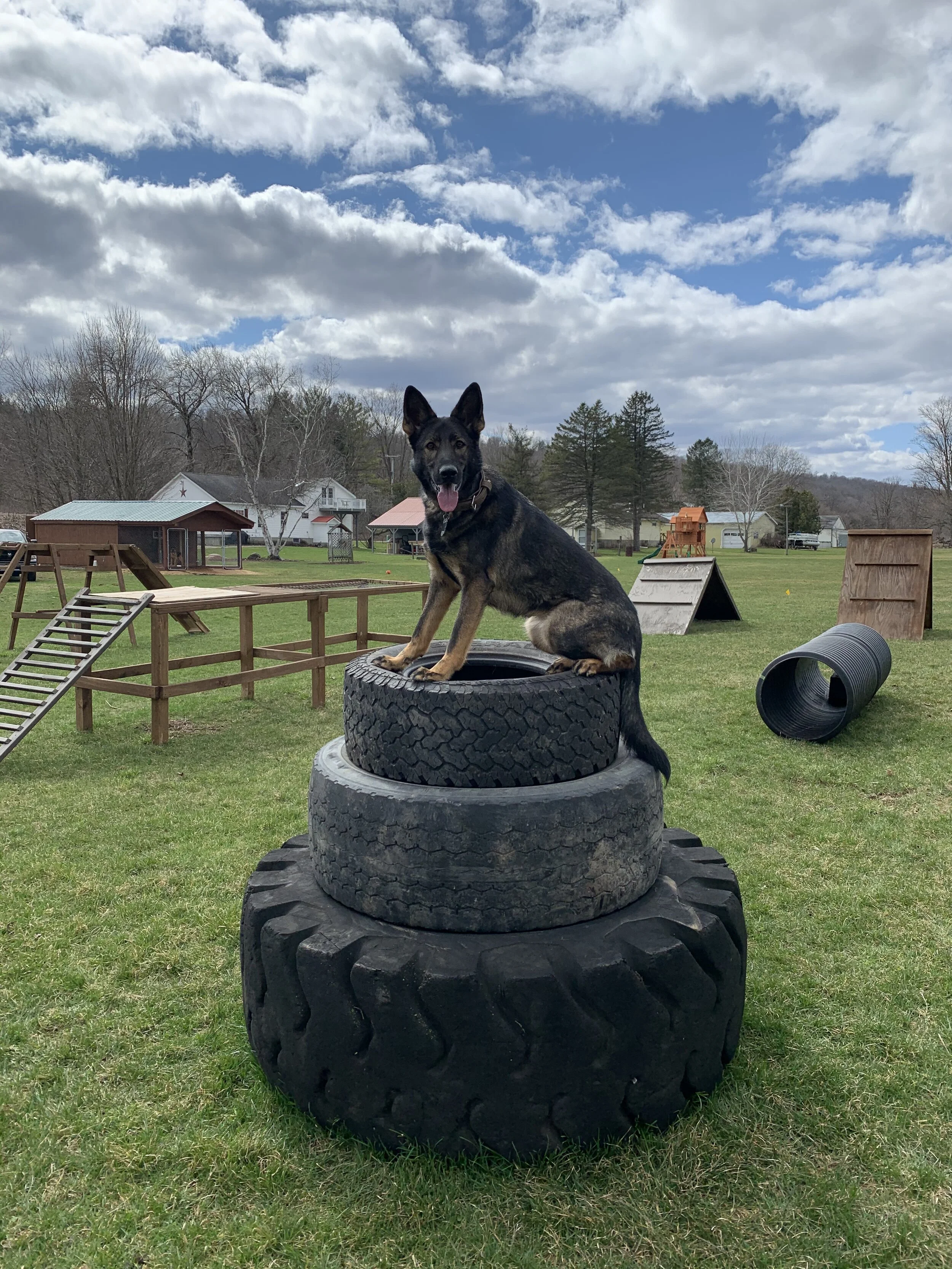
After that, I sat in on two client meetings.
The first was the Rottie. The second I watched the dog’s human step into the room, I recognised it — the nerves sitting in her shoulders, the micromanaging on the leash, the energy bleeding straight into her dog.
She kept looking toward me as if she had to explain her behaviour, and it wasn’t until the decoy/trainer asked her, “Why do you keep looking at her?” that she sort of stopped.
I then had to say, “I do exactly this, and this is exactly why I am here doing this course now.” I felt I needed to give a bit of an explanation why I was there too, as she was obviously conscious of there being ‘something’ wrong but not knowing how to fix it.
It seemed to have softened her a little, but I think she is one of those people that she either wants it all done by someone else, and doesn’t want to learn something new-OR-needs to walk away and think about things after the fact.
It felt like I was watching myself six weeks ago with Jett. Same over-arousal, same anxious handling, same cycle of “I’m trying so hard, why isn’t this working?”
It hit a nerve because I’ve been her. I know exactly what that feels like. And this is why I was sitting there as an observer and student in the process of doing the K9 Handler course. Because I want to be the best person I can be for my dog.
The second session was with a young girl coming to view a dog she was planning to buy — not as a pet, but for her future role as a K9 handler.
The atmosphere changed immediately.
When you’re selecting a dog for work, everything matters. It’s the first place you see how deeply the picture matters for the K9 handler just as much as the dog.
We were shown tactical withdrawals during her session — how to move out of a scenario cleanly, how the dog covers you, where you place your body, how to keep eyes on a threat while still controlling the dog.
It’s the kind of training most people never even see, and it was fascinating watching her process it all in real time.
It also showed me, how she as a K9 handler may fail.
When the decoy offered her the sleeve and to do a couple of bites, she didn’t even move. She stood totally still. She looked shy, withdrawn and to be honest, terrified but in a social way.
The decoy said, yell, make noise, bang, get the dog interested and focused on you. And she just stood there.
The other thing I noticed was that her mother spoke entirely for her. When the decoy asked her what she wanted to do career wise, she was barely able to answer. “Want to join the cops?” No she said. “Want to go to the military?” No, she said again, and shrugged her shoulders. The decoy/trainer kept asking and prodding her, and she just couldn’t answer. But mum was the one who was saying ‘this is her dream’ or ‘this is what she wants to do’.
Here’s the thing. If this was her dream, she would’ve been unstoppable. She would’ve been talking the decoys ear off, she would’ve had a million questions to ask. She would’ve been able to say things like, I watched this video, or read this article or saw this post and the dog and handler did x. Why? What is the purpose. She would’ve shown infinitely more interest in the fact that she was sitting opposite literally one of the best dog trainers I have ever met.
Jett’s trainer/decoy is legitimately a person who is dog intuitive and reads dogs. I literally record everything he says in my brain. Dog whisperer? You betchya. She wasted her opportunity and the time she had with the decoy who I believe is one of the best of the best in this country, and barely uttered a word…yet this was her ‘dream career’.
I’ve met people who wanted to be in my former career and who I ended up mentoring because they were so persistent. This young lady was the equivalent of sending a show line dog to a K9 training school and expecting it to have drive and to want to do the work.
She didn’t want it badly enough, in my opinion.
I’ve been on many recruitment panels and hired people for very specific and specialist roles in federal and state law enforcement. I’ve also been a panel member as an outsider to a vocation, a neutral person on the panel. There is no way in the world I would’ve hired someone like her.
She wouldn’t have even made it to interview stage.
I feel like for her, it was maybe an easy looking job to do. She’d walk around a static location with a dog, and it’d be fun.
But I personally felt she lacked the understanding needed or required to actually do the role of a K9 dog handler.
Those two sessions grounded me. They softened me a little, made me more present, more observant. They also made me hungry for more. They allowed me to use skills and knowledge from 17 years in a specialist law enforcement role in a way that I haven’t used it from the early days. I felt like I was going on a big taskforce or operation. It totally energised me.
And I think that’s why the next part of the day — the bitework — landed the way it did.
Only after all of that did I get to handle Venom.
Venom: The Sleeve, the Bite, and the Fear I Expected to Feel (But Didn’t)
Venom is six, fully trained, and very serious about his work. When Jett’s trainer asked me if I wanted to try the sleeve with him at the end of the session, I didn’t even think. My mouth just said yes.
Logically, I should’ve hesitated. A big part of my brain should’ve said, “Are you sure? That’s a trained protection dog coming at speed and about to bite you (through a really thick sleeve).”
But nothing in me hesitated. Not even for a second.
Venom came straight toward me and I felt the first impact through the thick sleeve — not pain, just this strong, solid pressure, like a heavy weight hitting and holding.
And instead of fear, the first thing I felt was excitement. I was exhilarated and laughing from joy. I think I said something like, “Don’t tell my husband but this is the best fun I’ve had in ages!”
Then I was given a slightly thinner sleeve because it was good to feel more, feel different pressure, and feel different parts of his bite.
I still can’t explain it. It just felt natural. Like my body already knew what to do without needing to think about it. Sure I was clunky, and probably looked foolish. But it was the safest place to do and try something like this. My decoy, Jett’s trainer, and 3 other handlers, and a VERY well trained dog.
My husband says I never give myself enough credit for how resilient and confident I actually am, especially when it’s something I genuinely want.
Maybe he’s right. Because that moment woke something up in me.
A kind of calm under pressure I’ve always had but has been turned off for a little while, the ability to work in environments of high stress and pressure — the same kind of calm you need as a K9 handler on the field.

Day Two: Daisy, Kira, and Watching a Dog Unlearn the Wrong Picture
The second day had a different energy. I worked Daisy first — three years old, all business, all intention. Then Kira, a pup still figuring everything out. They taught me a lot, but the biggest lesson actually came from watching Hunter.
Hunter is a corrections-trained dog who had started failing scenarios. He wasn’t the problem — the picture was.
The decoys who’d worked him before were too animated, too busy, too chaotic. They taught him the wrong picture without meaning to.
I’ve had the blessing and great opportunity to work with law enforcement and corrections dog handlers in my former career. So I know them, I know their dogs and I know the environment they work in. But being an observer in a highly tactical situation is much more different than the application of a fully trained and certified dog and handler on the job, compared to the training room, or boxing ring as Jett’s trainer calls it.
Watching the trainers strip everything back — slower movements, clean pressure, less noise — and watching Hunter start to think and respond again was honestly fascinating. It showed me how easily a dog can be led off the right path when the communication isn’t clear between dog and K9 handler.
That’s when it really clicked:
Decoys aren’t just “the person getting bitten.”
They’re teachers.
And dogs learn exactly what we show them — even when we don’t realise what we’re showing.
In Hunter’s case, he had to learn to respond when given the activation, and not when the decoy was bouncing around like a circus clown. Seeing the way the trainers had to reverse engineer the problem to then fix it was amazing.
Client Dogs, Real Problems, Real Progress
I watched several more client sessions throughout the day, but one dog really stayed with me: a young German Shepherd doing protection work who had been attacked by a pit bull x staffy. Since then, she’d developed dog aggression.
I know this in theory, but seeing it play out in front of me was different. You could see it in the way she watched the other dog — that quiet, tense bracing, like she was waiting for something bad to happen again.
They put her in a room with another dog who wasn’t reactive at all, plus a decoy who could control the whole situation. The idea wasn’t to ‘fix’ her or force her to behave. It was just to show her that nothing bad was going to happen this time — a lesson every K9 handler has to understand deeply.
I knew this already, but if a dog with that kind of history gets bitten or pressured again, it basically reinforces the fear and makes the aggression worse. So everything had to be clean and controlled.
Watching her slowly realise she was safe was really moving — her body just softened a bit, her breathing changed. It was the first time she’d been near another dog without expecting to get hurt. That moment stuck with me.
The trainers worked her in a double-sleeve drill beside another dog. At first you could literally see the tension bracing through her back. Then, slowly, the wins started stacking. A good rep. Another. A calm moment she didn’t think she could have. She was praised for every good decision she made. In fact, the entire room was brimming with energy, even I was yelling out “GOOD GIRL!” when she made good choices.
That’s how you fix things like that — small, clean wins in controlled environments, not forcing the dog to “get over it.”

At the very end, the decoy actually filmed me from the front while I held a sleeve on each arm — one for the GSD and one for the Mali.
From where I was standing, it was hard to see anything except the dogs in front of me and trying to keep my body position clean. But reviewing the video later was eye-opening. It felt like such a “developing K9 handler” moment — seeing mistakes and nuance only after the fact.
On the video it was so clear — you could literally watch her brain start to unravel that fear, inch by inch. Her eyes would flick to the Mali, then back to me, then back again, like she was checking an old story she’d been telling herself.
It made me realise how important it is to redirect a dog like that into positive wins, not let them lock onto whatever they’ve decided is a threat.
And also, how such rewiring needs to be done with professionals in a professional environment.
One clean moment at a time, she was rewriting her own picture.
Handler vs Decoy: Seeing Myself More Clearly
One of the biggest lessons from both days came from stepping into both roles — handler and decoy — and understanding that both shape the dog in different ways during the K9 handler course practical.
K9 Handling shows you how your own state affects your dog.
Decoying shows you how a dog reads intention, pressure, doubt, and clarity.
There was something about watching that Rottweiler handler, and then later feeling how different dogs hit the sleeve with different energy, that made everything click.
My mistakes with Jett weren’t because she’s reactive, or soft, or too driven.
It was because I was giving her the wrong picture:
The wrong state.
Too much anxiety, not enough clarity.
Being in the sleeve gave me empathy for both sides of the leash. I felt intention. I felt hesitation. I felt commitment.
And once you feel that, you can’t unsee it.
What I’m Bringing Back to Jett
When I got home I wrote these down right away. I couldn’t stop talking about it for about 4 days. That night, I couldn’t sleep throughout the night, and woke at about 2am just full of energy. And my body was exhausted from the sleeve work. As was my brain. I fully understood Jett’s post training snooze in the car!
A lot of things became very clear to me. The kind of things that only become clear when you’re in the middle of a K9 handler course practical, not reading about it online:
• If the picture is wrong, the behaviour will be too.
• Dogs respond to clarity, not wishful thinking.
• Decoys communicate as much as handlers do.
• My state sets Jett’s state every single time.
• Slow is fast when you’re fixing stress.
• Clean wins build confidence.
• Calm isn’t optional — it’s essential.
• Connection over correction, always.

Final Thoughts
These two days taught me exactly what I needed — not just for the course, but for Jett, and for myself.
I understand pressure differently now. I understand communication differently.
And I understand my dog far more deeply than I did a week ago.
••I did my course at NSTA Hillcrest & All Dogs Security & Training
If you want more of these raw, behind-the-scenes reflections, join my Stormforge Monthly newsletter. I save the real, messy, honest lessons for there — the ones that don’t make it into the polished educational posts.


Leave a Reply