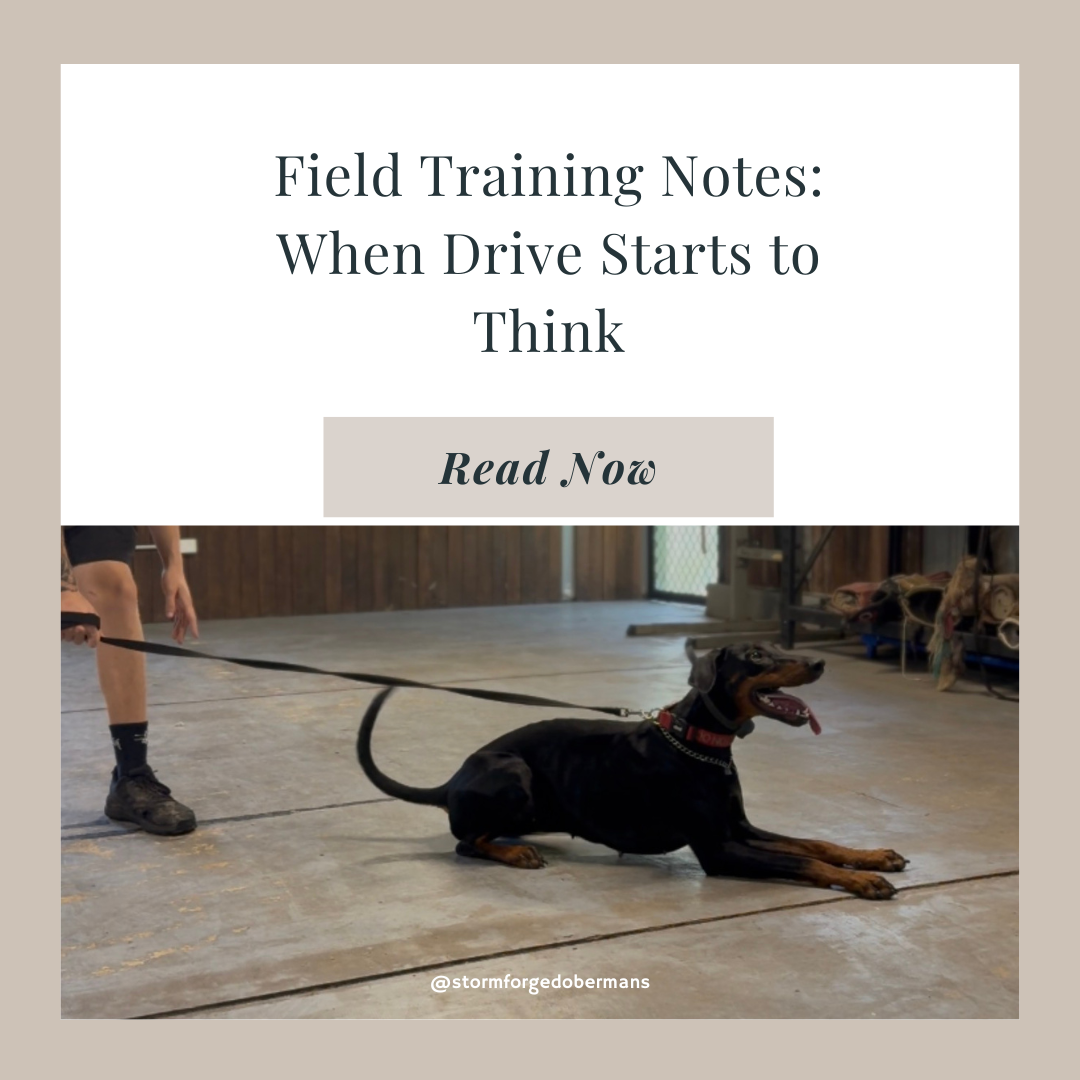
Doberman drive training doesn’t always look like explosive energy or visible intensity. I’ve started to notice something shifting in Jett since returning to work after the break.
It isn’t a loss of drive, and it isn’t shutdown. It feels more like she’s learning to think before she reacts, which in some moments looks like hesitation or uncertainty.
It’s not always easy to read, and I’m realising I have to pay closer attention to whether she’s disconnecting, or actually just beginning to process.
This session made that clearer than any of the ones before.
Table of Contents
Returning After a Break
Coming back after time away always feels a little different.
It’s not like starting again, but it isn’t just picking up where we left off either.
There’s a subtle reset that happens, not just for the dog but for me too. The rhythm changes. It takes a session or two to re-sync, to find the timing, to read the energy right.
I’ve noticed this before but never really paid attention to it. We tend to focus on whether the dog remembers the work, but there’s also this in-between space where the dog matures a little, thinks a bit more, resets something internally, and that means I have to adjust too.
Today felt exactly like that.
I could tell early in the session that her drive felt different. It wasn’t missing. It wasn’t low. It was just sitting deeper. Less on-the-surface and more buried under a thinking layer.
She used to react before she processed. Today I could see her processing before she acted. That’s not always a bad thing, but it does change how things feel.
It makes it harder to gauge whether she’s hesitating from uncertainty, or just learning to regulate and think.
It forces me to look closer.
Doberman Drive Training: Observing the Shift
I’ve been watching her a bit closer since coming back and it’s not that her drive is gone, it’s just sitting differently.
She isn’t exploding forward like she used to on every cue.
It used to be always on the surface, quick and a bit sharp, almost too ready.
Now it drops a little lower and I think some of that is maturity, some handler communication, some confusion, and maybe even her starting to think instead of just reacting.
We noticed when she takes a correction now, she doesn’t bounce straight back into drive.
She pauses.
Not worried, not stressed, just uncertain.
Almost like she’s running through options in her head. Should I go back in? Should I hold position? Do you want obedience? Do you want engagement? Do I offer you something?
That’s new for her. Before, she didn’t pause to ask. She just did. Now she pauses to read.
But also, that lack of pausing was also her being her reactionary little self. Before her break we struggled with calmness. Now that we have more calmness, we also have more thinking.
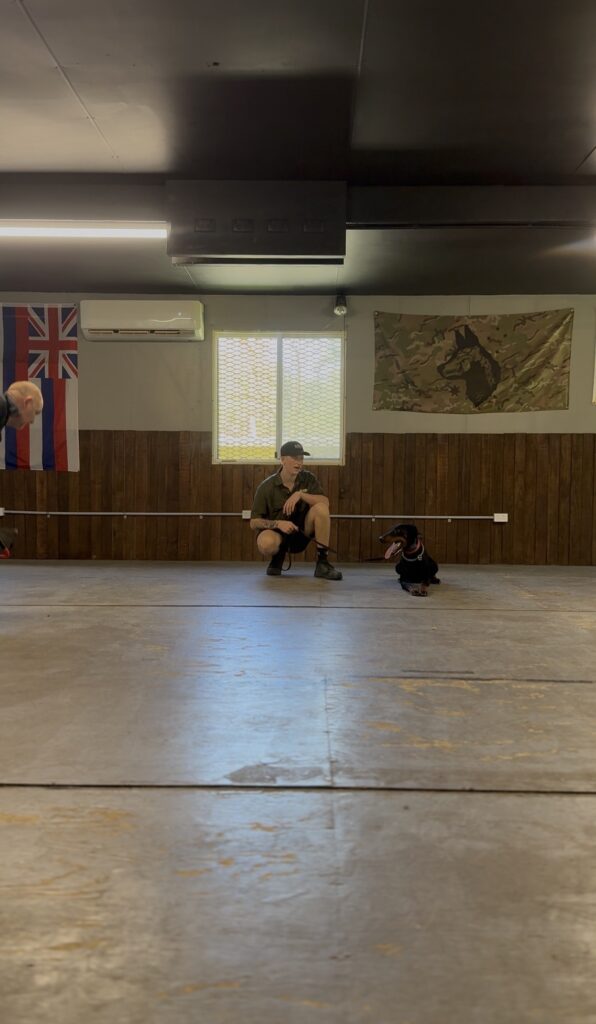
That pause is where I realised this isn’t drive loss. It’s a question. And my timing and clarity either answer that question, or I leave her hanging in it.
Today, I left her hanging a few times. I could actually see it happen. The processing face. The hesitation. Not bad behavior. Not disinterest. Just asking for clearer direction.
Understanding the Problem
Today was the first real day back deliberately working to build drive, not just doing obedience inside it, and it showed. Different, but good.
When her drive did show up, it was deep, not frantic. More thoughtful, not reactive. But it wasn’t as quickly available as before.
I had to invite it, not trigger it. That’s a big shift. Before, it was always ready to ignite; now, it needs a cleaner cue to come through.
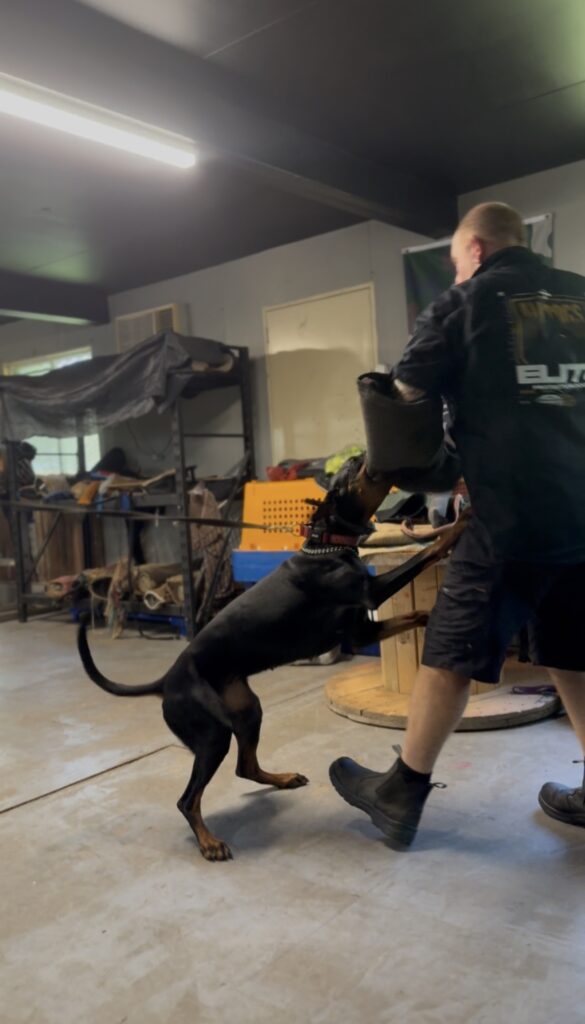
She did something she’s never done before. She moved around to the non-sleeve side of the decoy to get a dirty bite. It wasn’t sloppy. It wasn’t desperation. It was calculated. She saw an opening, assessed it, and went for it. She went looking for it. That was new.
I however, also let her have the bite which was an error on my part. I misread the cue from the decoy and then took too long to respond. We had a moment of chaos, but thankfully we record all our sessions so we could go back and see what we did.
We unintentionally reinforced it. All of us. Wrong timing, inconsistent responses, unclear body language. We went back through the footage afterwards and it was clear.
It wasn’t her messing up the scenario. It was us setting up an unclear picture.
That moment ended up being the most valuable part of the session. It made us slow down and re-examine our role in shaping her drive.
Her enthusiasm isn’t the only thing that builds, our picture does too. She’ll only ever be as clear as we make the work.
How Her Emotional Responses Are Changing
Something else I noticed today, and maybe it has been slowly building, is that her emotional response to mistakes feels different from how it used to.
Earlier in her training, if she got it wrong, she bounced straight back, almost too quickly, without considering what had happened.
Back then, it felt more like a reflex.
Today, it feels more like she actually weighs it. She takes it in. She doesn’t fall apart, but she does pause.
There’s a difference between hesitation and shutdown. Months ago, she didn’t hesitate at all. Now I think that small hesitation is actually her trying to interpret, not avoid. And that means I need to look closer at how I handle that moment.
This is where I have to keep checking myself. It’s easy to see that pause and assume her confidence is dropping.
But when I look closely, her body isn’t soft. She’s not uncertain in that emotional way. She’s steady, just waiting for clarity.
The uncertainty is in the communication, not in the dog. She’s not losing drive. She’s trying to understand how to use it. That’s new for both of us.
And because she is becoming more thoughtful, I have to adjust how I give information.
Before, I could cue, correct, and move on, and she would follow. Now, she needs a clearer picture.
It isn’t about bigger reactions or more energy. It’s about timing and showing her exactly what I want from that moment, without leaving room for guesses.
She’s not reactive anymore. She’s thinking. And that changes the whole feel of training.
The Unwanted Heel
We’d been working her on the sleeve, asking for a release and a re-engagement to the bark and hold, then a bite. She was clean on the release, but instead of staying committed to the work, she defaulted into a tidy little heel.
Not frantic. Not conflict-driven. Just neat and obedient. Too obedient.
There was nothing “wrong” about it, except that it was the wrong picture for that moment.
She didn’t know what we wanted, so she chose the safest, most correct thing she knows. Heel means she did her job. Heel means clarity. Heel means order.
That told me more than the bite did. She wasn’t choosing avoidance. She was choosing certainty.
Acting quick, and in a quick team huddle, our decoy instructed I recommand her activation after I ask her to leave the sleeve. “This should”, he said, “switch her mind back to the threat”.
So we repeated it, but this time we activated her the moment she released, so she didn’t get stuck in that obedience default.
It worked.
She stayed engaged when cued to release, and didn’t slip into heel on autopilot.
That told me something too — she isn’t shutting down, she’s trying to resolve confusion by defaulting to obedience.
That isn’t a drive problem. That’s a communication problem.
Not Drive Loss, Just Uncertainty
The most interesting thing about her right now is that she isn’t flat. She isn’t overly cautious. She isn’t losing interest. She’s just unsure how to process corrections while staying in drive, and we haven’t shown her that picture clearly before.
She’s trying to understand when correction means soften, when it means redirect, and when it means re-drive.
It feels like she is developing interpretations, but she doesn’t yet know which one belongs to which moment.
That’s why the hesitation is appearing.
Obedience isn’t the issue.
Drive isn’t the issue.
Communication is the issue.
Down in Motion as Resilience Work
Without getting too technical about it, down in motion is basically asking the dog to drop into a down command while you keep moving. It’s very specific as an obedience protection drill for protection sports like PSA.
You don’t stop, you don’t turn to face the dog, and you don’t help them with big signals or body language. You just give the cue and keep walking, and they have to drop instantly and stay connected, even though you’re moving away.
The whole point isn’t just the position of the dog, it’s whether they can take that command while still emotionally switched on, instead of switching off just because they’re stationary.
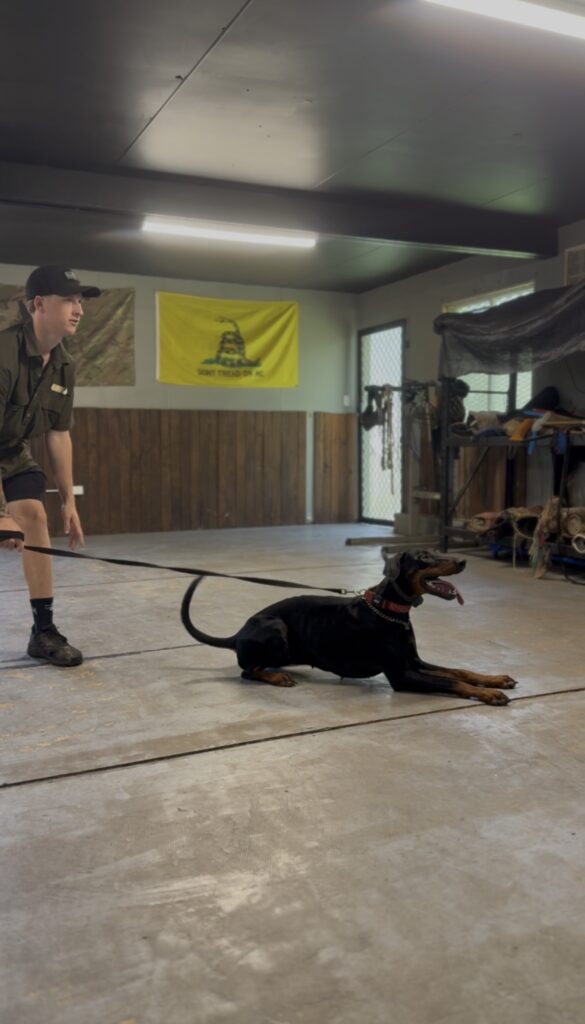
Long story short, it’s not about the down. It’s about whether they can hold clarity, engagement and self-control all at the same time.
To finish our session, we introduced down in motion drills. Not to drill obedience, but to work on resilience.
The aim wasn’t just to get her to drop. The aim was to get her to drop without emotionally disconnecting.
Could she take the down cue and stay plugged in?
Eyes up, brain on, still thinking, still engaged. That’s the whole point.
How the Drill Actually Builds Resilience
The way we ran down in motion today made it clear that the exercise isn’t really about the down at all. It’s about whether she can hold herself together emotionally while moving through activation, control, pause, and then reactivation, without dropping mentally.
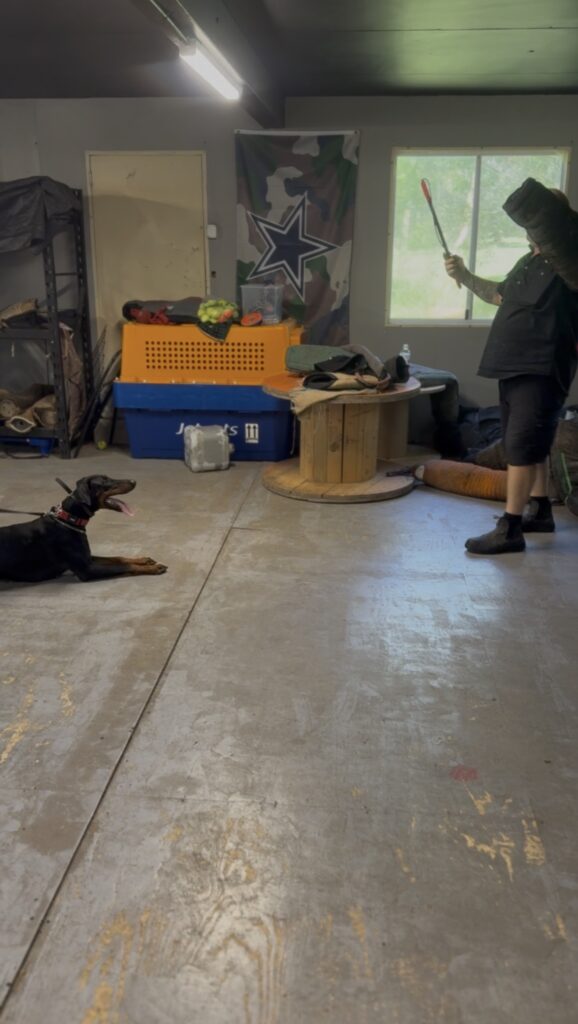
We did it with another trainer handling her. He gave her the activation cue and she moved in drive toward the decoy. Then, right before she could commit fully, he stopped her with that clear “no more action” body signal — hands up, pressure off.
That’s normally the point she would either expect a new cue, or switch into waiting mode. Instead, he asked for a down. She had to drop instantly, but still stay mentally plugged in, sleeve in sight, activation fresh, adrenaline up.
Then the decoy re-engaged, gave the activation again, and she was allowed to go back into drive.
So the picture became: drive up, drive paused, control, then drive up again.
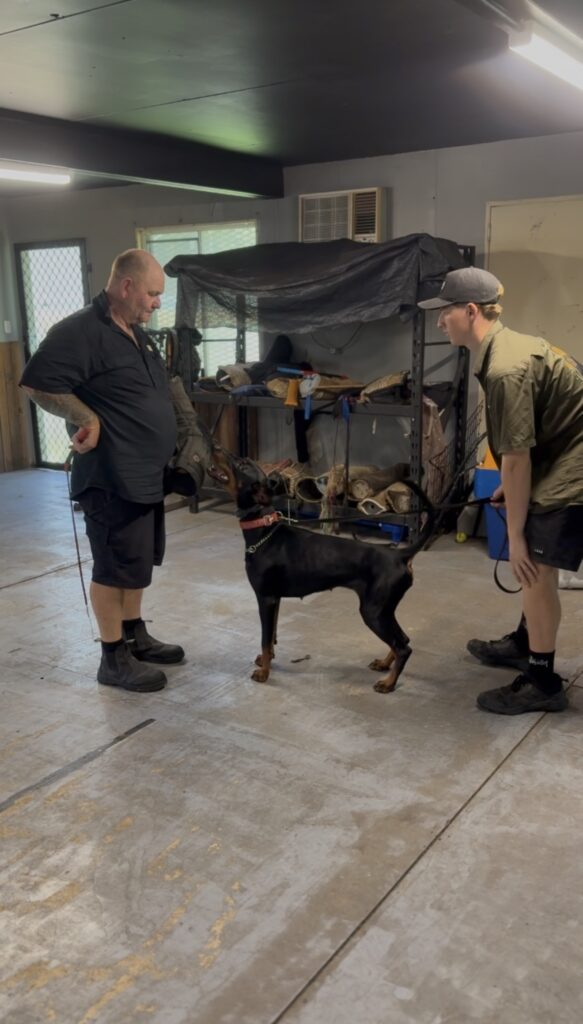
And the whole point is whether she can take that control moment without shutting off. A lot of dogs will hold the position but emotionally fall out of the work. That’s what we’re watching for.
It’s not testing if she’ll down. She will. It’s testing whether she can down without disconnecting. That’s the resilience part.
Some dogs collapse into obedience too readily. Others resist control. She sat somewhere in the middle — trying to understand if the down was the end of the work, an obedience moment, or just a temporary control point inside the work.
That’s where the value is. The drill teaches her that regulation doesn’t mean disengagement. She can hold the position and still stay alive in the work.
One variation we did had her recall to heel instead of re-engaging on the decoy, and even though it looked similar on the surface, the emotional requirement was different. She had to release, come in, and stay present without defaulting into compliance mode. Same principle — regulate without collapsing the work.
So the resilience isn’t built by the command. It’s built in the emotional gap between activation and reactivation, where she has to stay steady, not switch off, and not guess.
Learning to Regulate Without Disconnecting
I want to use down in motion as a way to teach her that regulation isn’t shut down. It can live inside engagement.
I want her to learn that she can regulate without disconnecting. That feels like the work she needs right now, more than extra agitation or clean obedience run-throughs.
It felt like the right place to finish, because she left the session engaged, not confused, not flat, not overworked. She wasn’t buzzing, but she was clear.
She doesn’t need more hype. She doesn’t need more pressure. She needs cleaner information.
And clarity is what she needs most at this stage.
Homework for This Week
My homework for this week is to spend time working on down in motion with her. Not just getting the physical position, but paying attention to how she emotionally sits inside it.
I want to see if she drops cleanly while staying mentally connected, or if she drops and detaches. That’s the difference I’m looking for.
I’ll start in low distraction first, then slowly bring in movement, activation, handler pressure, and see if she can stay emotionally switched on while physically in position.
No rushing. No drilling. Just reading.
Final Thoughts
What I’ve learned from this session is that her drive hasn’t dropped. It’s grown up a little. It’s quieter, slower to surface, but sits deeper when it does.
She’s thinking, and with that comes hesitation. It’s not bad hesitation. It’s not conflict hesitation. It’s a question.
This is where it matters that she is a Doberman.
They aren’t push-start dogs like a Malinois where you wind them up and send them. They sit in the top five most intelligent breeds for a reason.
They don’t just do, they interpret.
They look for meaning. That means timing, clarity, correction, and drive all have to make sense to them, and I have to adjust to the dog in front of me at the time.
It doesn’t mean softer, and it doesn’t mean slower. It just means clearer.
And our job now is to answer that question properly, not rush her out of it.
She can’t make good choices if the choices aren’t clear. That’s on me, not on her.
The pause isn’t the problem. The pause is where the learning sits.
Leave a Reply