
Table of Contents
Raising high drive Dobermans is a rewarding challenge, but it comes with unique pitfalls many owners don’t expect.
Dobermans are striking, powerful, and deeply loyal dogs. For many people, the image of a Doberman represents strength, elegance, and courage. But beneath that sleek coat and impressive stance lies a breed with an extraordinary amount of drive and intensity—especially when we’re talking about working-line Dobermans.
These are not dogs that can simply “slot in” to a typical suburban pet lifestyle without intentional training, structure, and outlets for their drive. They require a specific kind of handling, one that blends firmness with fairness, structure with connection, and power with sensitivity.
Unfortunately, many well-meaning owners run into trouble because they treat their high-drive Doberman the same way they’d raise an easier companion breed. The result? Frustrated dogs, exhausted owners, and sometimes dangerous situations.
In this article, I want to share some of the biggest mistakes people make when raising high-drive Dobermans. I’ll also weave in insights from my own experiences training with my dogs, like Jett and Cookie, and from the philosophy I’ve been developing through the Ironbond Method—a connection-based approach to working with high-drive dogs.
Understanding the Needs of a High Drive Doberman
If you’re raising a Doberman now or thinking of bringing one into your life, this guide will help you avoid the pitfalls and set you and your dog up for success.
1. Treating Raising High Drive Dobermans Like Pet Dogs
One of the most common mistakes is assuming a Doberman is just another pet dog who’ll be content with daily walks and casual playtime. While pet-bred Dobermans might manage in this environment, working-line or high-drive Dobermans need far more than that.
These dogs are wired for work and purpose. Historically bred for protection and service, their drive compels them to seek challenges, stimulation, and outlets for their energy. When they don’t get it, that energy doesn’t just vanish—it turns inward, often surfacing as destructive chewing, constant demand barking, reactivity, or frantic energy that never seems to settle.
A high-drive Doberman without a job is like an athlete stuck in a classroom all day. They’ll find something to do—usually something you don’t want.
What to do instead:
Give your Doberman a structured role. This doesn’t always mean Schutzhund or protection work, though those are fantastic outlets. It can also mean tracking, advanced obedience, scent detection games, or even structured tug sessions where the rules are clear. The key is not just exercise, but purposeful exercise.
2. Relying Only on Obedience Commands
Dobermans are smart—sometimes frighteningly so. They pick up obedience cues quickly and can perform flashy routines that impress strangers at the park. Many owners mistake this for true control or connection. One of the biggest traps when raising high drive Dobermans is relying only on obedience commands, while ignoring their emotional state.
Here’s the problem: a high-drive Doberman can execute a sit, down, or heel perfectly in training, but still spin out of control in a real-world scenario if their emotional state isn’t managed. Obedience doesn’t always equal balance.
This is where connection matters. In the Ironbond Method, I emphasize that the dog’s relationship with you—your calmness, clarity, and ability to read their state—comes before the command. Obedience is the product of connection, not the replacement for it.
Example: My young female Jett can nail a recall on a short leash. But when her drive spikes around another animal, her brain freezes in “fixation mode.” No command alone brings her back—what works is interrupting her body, moving her forward, and then reconnecting her brain to me. That’s connection, not just obedience.
What to do instead:
Yes, teach obedience, but don’t stop there. Build trust, respect, and emotional regulation alongside your training. Notice your dog’s state before giving commands. Sometimes what they need isn’t another “sit” but guidance back into balance.
3. Neglecting Early Socialisation
Dobermans have a reputation for being naturally protective and suspicious. While that’s true, it’s a trait that can turn into fear-based reactivity if the dog isn’t properly socialised early. Socialisation is one of the most critical parts of raising high drive Dobermans into stable adults.
Many owners think socialisation just means letting the puppy meet lots of people and dogs. But for a Doberman, it goes far deeper. They need exposure to varied environments, unusual surfaces, noises, and controlled stressors—followed by recovery. That last part is key.
A Doberman pup should learn how to handle challenges and then settle again, so they build resilience instead of reactivity. Without that, you can end up with a dog who barks at everything new, stiffens around other dogs, or becomes a liability in public.
What to do instead:
- Start early, but always prioritize safety and confidence.
- Expose your pup to new experiences, but in small doses they can process.
- Focus on recovery: reward calmness after stress, not just exposure during it.
This balance between exposure and recovery builds the kind of confident dog who can walk through a crowded street or onto a training field without melting down.
4. Ignoring Drive Management
Drive is the Doberman’s superpower—but unmanaged, it’s a nightmare. Drive management makes or breaks success when raising high drive Dobermans.
Some owners think they can just “let the dog run it out” in the yard or dog park. But high-drive Dobermans don’t just need physical outlets—they need structured outlets. If you don’t provide one, they’ll create their own, and it usually isn’t pretty.
Unmanaged drive often looks like:
- Obsessive ball chasing without an off-switch.
- Frenzied leash pulling.
- Spinning up to aggression when overstimulated.
These aren’t signs of a “bad dog.” They’re signs of a dog with drive but no guidance.
What to do instead:
Channel that drive into structured activities:
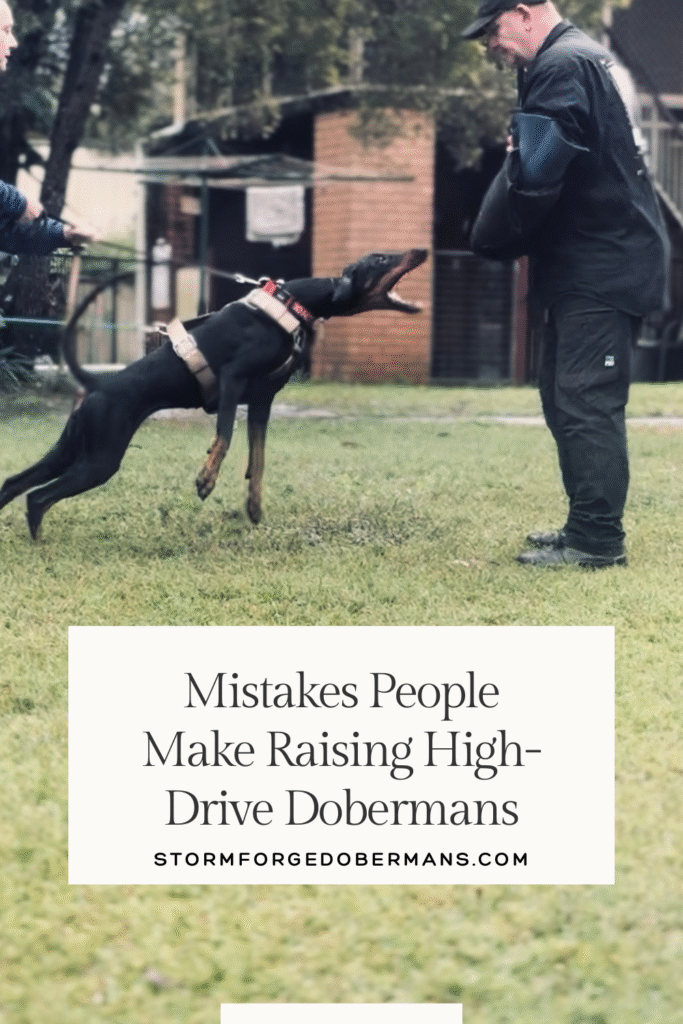
- Protection/bite work: teaches control under high arousal.
- Scent games/tracking: harnesses focus and problem-solving.
- Tug with rules: builds relationship and an on/off switch.
Just as importantly, teach decompression. After drive activities, provide structured calm time—like place training or calm leash walking. A Doberman with an off-switch is a Doberman you can live with.
5. Underestimating Their Sensitivity
Here’s a paradox: Dobermans are tough enough to face down threats, yet sensitive enough to crumble under harsh handling or chaotic environments.
High-drive Dobermans are often emotionally intense. They pick up on your tone, your body language, even your mood. A handler who’s erratic, inconsistent, or heavy-handed can damage trust and create a dog who either shuts down or fights back.
Example: Cookie, one of my girls, is bold but incredibly tuned in. If I raise my voice out of frustration, she stiffens and disconnects. If I guide her calmly, she flourishes.
What to do instead:
- Be clear, calm, and consistent.
- Correct when necessary, but don’t nag or punish out of frustration.
- Balance firmness with fairness—Dobermans respect strength, but they bond through trust.
This sensitivity is also what makes them so loyal. When you handle them with respect, they’ll give you everything.
6. Expecting Them to Mature Too Quickly
Many people forget that Dobermans, especially working lines, mature slowly. Physically, they may look adult by 12 months, but mentally, they’re still puppies in many ways. Adolescence is the hardest stage when raising high drive Dobermans because maturity doesn’t come as fast as owners expect
Rushing a young Doberman into heavy training or expecting them to behave like a seasoned adult too early is a recipe for frustration.
What to do instead:
- Give them time to mature mentally.
- Build foundation skills gradually.
- Accept that adolescence will be messy—and keep guiding them consistently.
Patience pays off. The 18-month-old Doberman who seems wild today can be an incredible partner by 3 or 4 years old if you stay the course.
7. Forgetting That Connection Is Everything
At the heart of all these mistakes is one truth: high-drive Dobermans need connection as much as they need control.
Yes, they’re powerful working dogs. Yes, they need structure, training, and outlets. But what really unlocks their potential is the bond between dog and handler.
This is why I’m developing the Ironbond Method. It’s about more than obedience—it’s about creating a cycle of trust, movement, and connection that keeps the dog’s brain engaged and balanced, even under pressure.
When you have that, mistakes become opportunities, training becomes partnership, and your Doberman becomes the extraordinary companion they’re meant to be.
Final Thoughts
- High-drive Dobermans need a mixture of leadership, love and obedience.
- Avoiding common mistakes keeps them balanced and safe.
- Connection, drive management, and trust are your best tools.
Raising a high-drive Doberman is not for the faint of heart. At the heart of raising high drive Dobermans is connection—not just control. These dogs demand time, energy, and commitment. But if you avoid the common mistakes—treating them like pets only, relying solely on obedience, neglecting socialisation, ignoring drive management, underestimating their sensitivity, rushing maturity, and forgetting connection—you’ll unlock the true potential of this incredible breed.
You won’t just have a dog who obeys commands. You’ll have a partner—loyal, powerful, sensitive, and connected. A dog who doesn’t just live with you, but works with you, grows with you, and bonds with you in a way few other breeds can match.
Leave a Reply