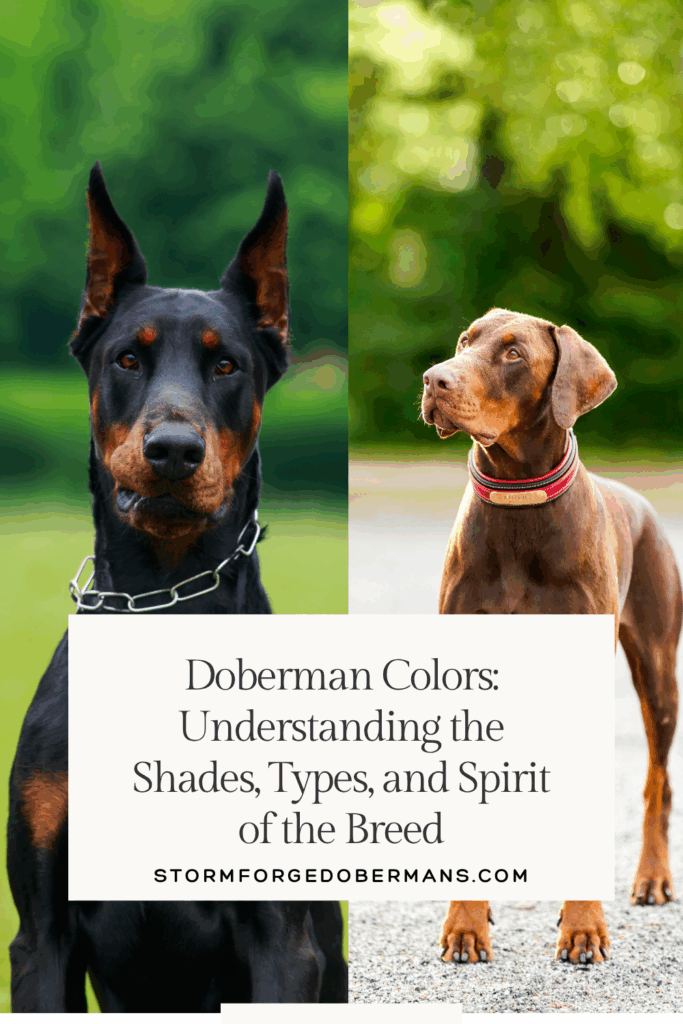
Doberman colors reveal more than just aesthetics—they reflect the breed’s deep history, versatility, and soul. The Doberman Pinscher stands as one of the most recognizable and respected breeds in the world, admired not only for its sleek outline and athletic build but for its intelligence, loyalty, and purpose-driven nature.
When you first encounter a Doberman, it’s hard not to feel their presence. There’s something magnetic about the way they move—alert yet composed, powerful yet graceful. But beneath that commanding exterior lies a dog of remarkable sensitivity. They read their people with uncanny precision, feeling tension before words are ever spoken.
And while their colors—black, red, blue, fawn, and occasionally white—make each one distinct, the truest reflection of a Doberman isn’t seen in their coat at all. It’s found in their connection to the person standing beside them.
From the deep gloss of a black coat to the rare shimmer of blue or fawn, the variety of Doberman colors mirrors the diversity found in their temperaments and lineage. And beyond color, the subtle distinctions between the American and European Doberman—each shaped by decades of selective breeding for different purposes—reveal the breed’s adaptability across continents and lifestyles.
In this guide, we’ll explore the colors and types of the Doberman Pinscher, not as mere variations of shade and size, but as reflections of genetics, history, and relationship. Because while appearance may draw us in, it’s the trust, the drive, and the shared energy between dog and human that define the Doberman’s true essence.
Table of Contents
The Spectrum of Doberman Colors
Dobermans come in several officially recognized colors, each carrying its own unique beauty, genetics, and subtle nuances in maintenance and care.
1. Black and Tan – The Iconic Standard
When people imagine a Doberman, they often see the classic black and tan—a jet-black coat gleaming under the light, contrasted by rust markings that define the muzzle, chest, legs, and beneath the tail. This coloration is timeless, evoking the very essence of the breed’s power and elegance.
Black and tan Dobermans often embody what most envision when they picture a protection dog—confident, striking, and alert. The black pigment (eumelanin) is dominant in the breed, and when combined with correct genetics, produces the deep, glossy finish that show lines strive for. With a balanced raw diet and regular coat care, their shine becomes almost mirror-like—a visual reflection of vitality.
2. Red and Tan – The Warm Ember
The red and tan Doberman is equally captivating but radiates a warmer energy. Their coat ranges from rich mahogany to a deep chocolate hue, depending on genetics and light exposure. These Dobermans often have a softer visual impression, but their temperament is just as intense and driven.
In some lights, the red coat almost glows—a subtle reminder that this breed is as fiery in spirit as it is in appearance. Reds tend to fade slightly in sunlight, so their coats benefit from extra nutritional support through omega-3 fatty acids and zinc to maintain depth and shine.
3. Blue and Tan – The Smoky Shadow
Blue Dobermans possess a steel-gray or slate tone—a dilution of the black pigment. This rare coloration gives them a cool, mysterious look that turns heads everywhere they go. However, blue Dobermans can be prone to a condition known as color dilution alopecia (CDA), which may cause thinning hair or patchiness over time.
A healthy skin and coat routine—balanced nutrition, gentle grooming, and minimal chemical exposure—helps mitigate the risk. Many owners find that the blue Doberman’s subtle shimmer and confident presence make this variety unforgettable.
4. Fawn and Tan (Isabella) – The Whispered Rarity
The fawn or Isabella Doberman is the dilute version of red, producing a soft beige or silvery cream tone with tan accents. Their ethereal coloring almost makes them appear carved from bronze under sunlight.
Like blues, fawns may also carry the gene for CDA, so it’s essential to choose reputable breeders who prioritize health over novelty. Despite their rarity, fawns hold a quiet grace—a gentle energy that seems to soften their intensity without dulling their intelligence or loyalty.
5. White Dobermans – The Controversial Enigma
Perhaps the most debated of all, the white Doberman carries a partial albino gene that dilutes pigmentation almost completely, resulting in a pale ivory coat, pink nose, and light eyes.
While undeniably striking, this color is controversial for good reason. The gene responsible for the white coat can be linked to sensitivity to light and potential vision or hearing issues. Ethical breeders rarely pursue this color due to the health implications, emphasizing that what makes a Doberman exceptional has nothing to do with novelty or rarity—but with sound temperament, health, and working ability.
White Dobermans remind us that not everything rare is right. Their existence is a window into how human desires can sometimes distort the integrity of a breed when aesthetics are placed before function.
The Two Types of Doberman: American vs European
Beyond color lies another defining trait of the breed: type. Though both share the same origin, the Doberman diverged into two distinct lines over the last century—American and European—each reflecting a different vision of what the breed was meant to be.
The American Doberman – Refined and Family-Focused
The American Doberman, developed primarily through show breeding, embodies refinement and grace. With a slightly lighter frame, smoother angles, and a longer neck and head, these dogs often excel in the conformation ring. Their movement is fluid and balanced, almost effortless to watch.
But beyond the aesthetics lies a temperament intentionally softened over time. American Dobermans tend to be more sociable, easygoing, and family-oriented, making them excellent companions for active households. They’re still protective by nature—loyal and aware—but often display a more measured response to new people or environments.
Within the American type, there are show lines (bred for structure and temperament ideal for the ring) and working lines (bred for sport, obedience, or service work). True working-line American Dobermans are less common but can display impressive drive when bred with intention.
The key word here is balance: American Dobermans are designed to fit modern life while preserving the breed’s elegance and devotion.
The European Doberman – Power and Presence
In contrast, the European Doberman remains closer to the breed’s original purpose: a working guardian. Developed under stricter European breeding standards, this type is more substantial in bone, muscle, and presence.
European Dobermans often display a broader chest, heavier head, and a more intense, alert expression. They’re not just beautiful—they command respect. These dogs are bred under temperament testing regulations like the ZTP, ensuring stable nerves, courage, and working aptitude.
Their energy levels are typically higher, their focus sharper, and their desire to work stronger. For handlers seeking a dog with real drive—whether for IGP, PSA, or personal protection—the European Doberman is often the go-to.
Within the European type, show lines are still athletic and confident but more social and manageable, while working lines are intense, task-driven, and require a confident, consistent handler who understands drive management and communication.
Owning a true European working Doberman is a commitment to structure, leadership, and connection—it’s not a breed that simply lives alongside you, but one that lives through you.
American vs European: Beyond the Look
It’s tempting to compare the two types through a lens of superiority, but the truth is more nuanced. Neither is “better.” What matters is alignment—between the dog’s genetics and the handler’s lifestyle, energy, and goals.
An American Doberman might thrive as a family guardian with daily runs and mental stimulation, while a European working-line Doberman could crumble in boredom without structured outlets for their drive.
Choosing between the two isn’t just a visual decision—it’s an emotional one. It’s about understanding what type of energy you want to live with every day. Do you want refinement and ease, or intensity and challenge? Both can be extraordinary when matched with the right home.
Choosing the Right Doberman for You
When people begin searching for a Doberman, they often start with what they can see—color, size, or pedigree. But the real journey begins when you start looking at what you feel around them.
Spend time with breeders who prioritize temperament and nerve stability, not just titles or color genetics. Observe how the dogs carry themselves, how they recover from pressure, and how they connect with their handler.
Ask questions about early imprinting, exposure to environments, and how puppies are raised between weeks three and eight—that window determines confidence for life. Look for breeders who don’t just produce dogs but cultivate relationships, guiding their pups through trust and early connection.
A black or red coat won’t tell you how a dog will behave under stress or how quickly they recover from correction. A European pedigree won’t guarantee confidence if early imprinting or socialization was neglected.
Whether you’re drawn to the gleam of a black and tan or the warmth of a red, remember that what matters most is energy alignment. Choose a dog whose drive and energy complement your lifestyle, not clash with it. A working-line Doberman in a sedentary household may become frustrated, while a low-drive companion won’t satisfy someone seeking to train in protection sports.
The most rewarding partnerships happen when handler and dog meet at the same frequency—where purpose, patience, and play converge.
That’s the real beauty of the breed: their ability to mirror you. When you show up grounded, calm, and connected, your Doberman meets you there. When you show tension, they amplify it. Their color, type, or size may draw your eye—but their spirit will reflect your own.
Final Thoughts: Beyond Color and Type—Toward Connection
Dobermans are often described by what we can see—the glint of their coat, the strength of their stance, the intensity in their gaze. But what truly defines them isn’t visible at all. It’s felt.
A Doberman’s essence is connection. It’s the invisible thread between handler and dog—the same one that has carried this breed through war, service, sport, and family life for over a century.
Whether you’re drawn to the commanding presence of a European or the refined grace of an American, remember this: every Doberman reflects the hands that raise it.
When you build from connection—when you train through trust rather than control—you’ll see the breed’s truest color: loyalty, embodied.
In the Ironbond philosophy, connection comes before control. When your dog feels understood, safety replaces tension, focus replaces reactivity, and partnership replaces pressure. A Doberman raised this way doesn’t just obey—they attune. And that is where their brilliance shines brightest.
Leave a Reply